Indigenous Rock the Vote: Mobilizing for Change in 2025

Your Voice Matters – Your Vote Counts During the 2025 federal election in Canada, the importance of Indigenous participation in the politica...

Showing posts with label carney. Show all posts

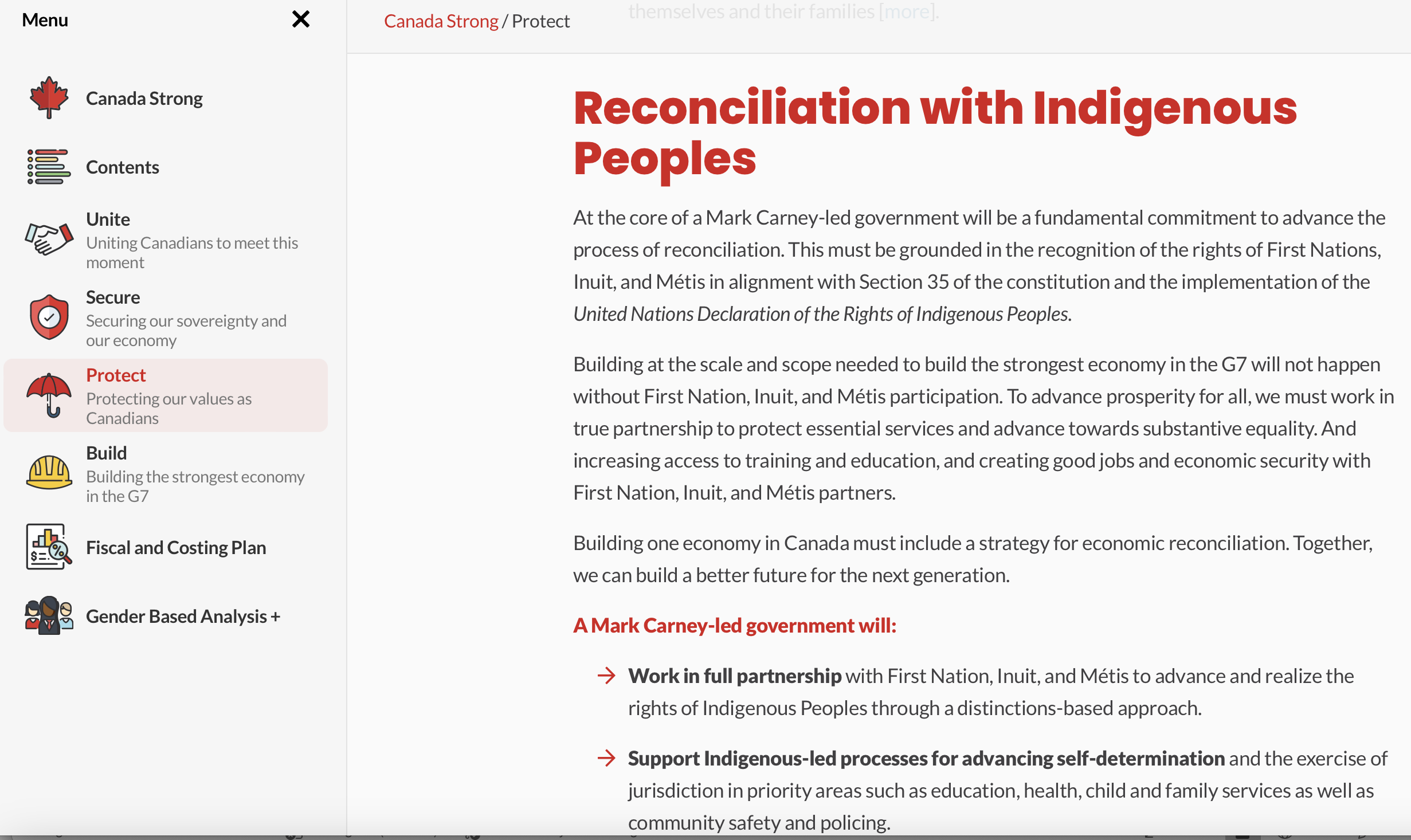
Comparing Mark Carney's 2025 Liberal Plan to Trudeau’s Record: What Does It Mean for Indigenous Peoples?

As Canada’s 2025 federal election approaches, the political landscape is shifting with new leadership under Mark Carney. As we evaluate the Liberal Party’s election plan under Carney’s leadership, it’s essential to compare it with the current Liberal government’s record under Prime Minister Justin Trudeau—especially in terms of its impact on Indigenous peoples.


While Carney's platform offers ambitious goals and a focus on economic reconciliation, some areas of concern and gaps in comparison to Trudeau’s actual policy actions need to be examined.


1. Economic Reconciliation: Carney’s Vision vs. Trudeau’s Actions

  • Mark Carney’s Plan:
    • Carney's platform emphasizes economic prosperity for Indigenous peoples as a key element of reconciliation. He proposes economic partnerships to increase participation in Canada’s economy, aiming to create good jobs, economic security, and growth in First Nations, Inuit, and Métis communities.
  • Trudeau’s Record:
    • Under Trudeau, the government has made significant investments in Indigenous communities, including Indigenous housing, healthcare, and education. Trudeau’s government has also focused on economic programs that include Indigenous youth entrepreneurship and employment.
    • However, Indigenous communities continue to face challenges related to economic inequality, and some of the promises on economic reconciliation remain unmet. The clean water crisis and housing shortages are examples where action is still required.

Comparison: Carney’s platform emphasizes economic reconciliation with Indigenous participation at its core, but it lacks concrete measures that have been seen in Trudeau’s term, such as funding for specific Indigenous programs or direct action on urgent needs like clean drinking water.

2. Indigenous Self-Determination: Carney’s Commitment vs. Trudeau’s Efforts

  • Mark Carney’s Plan:
    • Carney proposes working in full partnership with Indigenous peoples and advancing self-determination. His platform highlights support for Indigenous-led processes in areas like education, health, child welfare, and community safety.
  • Trudeau’s Record:
    • Trudeau’s government has made substantial progress in supporting Indigenous self-determination with initiatives like self-government agreements, the Indigenous Languages Act, and the Indigenous Child and Family Services Act (Bill C-92).
    • However, challenges remain in empowering Indigenous communities to fully exercise self-governance, especially in remote areas and communities that still rely on federal intervention for basic services.

Comparison: Carney’s commitment to Indigenous self-determination mirrors some of Trudeau’s initiatives, but the implementation of these programs under Trudeau’s government has faced significant challenges, particularly in terms of resources and capacity building for Indigenous communities to take on full governance.

3. Addressing Historic Injustices: Carney’s Pledge vs. Trudeau’s Accountability

  • Mark Carney’s Plan:
    • Carney promises to move forward with the Truth and Reconciliation Commission's Calls to Action and support Indigenous communities in addressing the unmarked graves of residential school children.
    • He also expresses support for implementing the National Inquiry into Missing and Murdered Indigenous Women and Girls and calls for justice through a national action plan.
  • Trudeau’s Record:
    • Trudeau’s government has made significant strides in addressing historical injustices, including advancing residential school compensation, supporting landmark legislation like Bill C-92 on Indigenous child welfare, and taking steps toward closing the gap in services between Indigenous and non-Indigenous peoples.
    • However, Trudeau’s action on MMIWG and the uncovering of unmarked graves at residential schools has been slow, with many Indigenous leaders pointing to the government’s inadequate response.

Comparison: While both Carney and Trudeau acknowledge historical wrongs, Carney’s plan lacks the specific programs that Trudeau’s government has begun to implement, though progress has often been slow or stalled due to bureaucratic barriers and lack of follow-through.

4. Clean Water: Carney’s Silence vs. Trudeau’s Ambiguity

  • Mark Carney’s Plan:
    • Carney's platform is notably silent on the clean water issue, which continues to be one of the most pressing needs for many Indigenous communities. While he discusses economic reconciliation, clean drinking water—a fundamental human right—is not directly addressed in his plan.
  • Trudeau’s Record:
    • Trudeau’s government made a significant promise to eliminate long-term drinking water advisories in First Nations communities by 2021. While progress has been made, many communities are still waiting for clean water, and some advisory issues persist.
    • However, the lack of timely action and implementation of these promises remains one of the criticisms of Trudeau’s term.

Comparison: Carney’s failure to address clean water is a significant gap in his platform compared to Trudeau’s government, which at least acknowledged the issue and made commitments. The lack of clean water in Indigenous communities remains a key issue that needs immediate attention in any reconciliation plan.


Conclusion: Comparing Visions for Indigenous Peoples

Both Mark Carney’s and Justin Trudeau’s platforms acknowledge the importance of reconciliation and the need to advance Indigenous rights. However, there are distinct differences in how these commitments are structured and presented.

Carney’s plan is ambitious, but it lacks the specifics needed to address the urgent needs of Indigenous communities, especially on issues like clean water. Trudeau’s record, though imperfect, includes more concrete actions on self-determination, historical reconciliation, and social issues like child welfare and language preservation.

For Indigenous peoples, the question remains: Will these commitments result in real change, or will they be another round of unfulfilled promises? The challenge for Indigenous voters in the 2025 election is to ensure that meaningful action on these issues remains the top priority for all political leaders.

#cdnpoli #IndigenousRockTheVote Indigenous Rock The Vote IndigenousRockTheVote.ca 


Comparer le plan libéral de 2025 de Mark Carney à l'historique de Trudeau : Qu'est-ce que cela signifie pour les peuples autochtones ?

À l'approche des élections fédérales de 2025 au Canada, le paysage politique évolue sous une nouvelle direction avec Mark Carney. Alors que nous évaluons le plan électoral du Parti libéral sous la direction de Carney, il est essentiel de le comparer à l'historique actuel du gouvernement libéral sous le Premier ministre Justin Trudeau, notamment en ce qui concerne son impact sur les peuples autochtones.


Bien que la plateforme de Carney offre des objectifs ambitieux et un accent sur la réconciliation économique, certains domaines de préoccupation et des lacunes par rapport aux actions politiques concrètes de Trudeau doivent être examinés.

1. Réconciliation économique : Vision de Carney vs Actions de Trudeau

Le plan de Mark Carney :
La plateforme de Carney met l'accent sur la prospérité économique des peuples autochtones comme un élément clé de la réconciliation. Il propose des partenariats économiques pour accroître la participation à l'économie canadienne, visant à créer de bons emplois, la sécurité économique et la croissance dans les communautés des Premières Nations, des Inuits et des Métis.


L'historique de Trudeau :
Sous Trudeau, le gouvernement a effectué des investissements significatifs dans les communautés autochtones, y compris dans le logement autochtone, les soins de santé et l'éducation. Le gouvernement de Trudeau s'est également concentré sur des programmes économiques incluant l'entrepreneuriat et l'emploi des jeunes autochtones.
Cependant, les communautés autochtones continuent de faire face à des défis liés à l'inégalité économique, et certaines des promesses de réconciliation économique restent non réalisées. La crise de l'eau potable et les pénuries de logements sont des exemples où des actions sont encore nécessaires.

Comparaison :
La plateforme de Carney met l'accent sur la réconciliation économique avec la participation des peuples autochtones au cœur, mais elle manque de mesures concrètes, comme celles observées sous le mandat de Trudeau, telles que le financement de programmes autochtones spécifiques ou l'action directe sur des besoins urgents comme l'eau potable.

2. Autodétermination des peuples autochtones : Engagement de Carney vs Efforts de Trudeau

Le plan de Mark Carney :
Carney propose de travailler en partenariat total avec les peuples autochtones pour faire avancer l'autodétermination. Sa plateforme souligne le soutien aux processus dirigés par les Autochtones dans des domaines tels que l'éducation, la santé, la protection de l'enfance et la sécurité communautaire.

L'historique de Trudeau :
Le gouvernement de Trudeau a réalisé des progrès substantiels pour soutenir l'autodétermination des peuples autochtones avec des initiatives comme les accords d'autonomie gouvernementale, la Loi sur les langues autochtones et la Loi sur les services à l'enfance et à la famille des Autochtones (projet de loi C-92).
Cependant, des défis subsistent pour autonomiser les communautés autochtones afin qu'elles exercent pleinement leur gouvernance, surtout dans les régions éloignées et les communautés qui dépendent encore de l'intervention fédérale pour les services de base.

Comparaison :
L'engagement de Carney envers l'autodétermination des peuples autochtones reflète certaines des initiatives de Trudeau, mais l'implémentation de ces programmes sous le gouvernement de Trudeau a rencontré des obstacles importants, notamment en termes de ressources et de développement de la capacité des communautés autochtones à assumer pleinement leur gouvernance.


3. Traiter les injustices historiques : Engagement de Carney vs Responsabilité de Trudeau

Le plan de Mark Carney :
Carney promet de poursuivre les travaux de la Commission de vérité et réconciliation et de soutenir les communautés autochtones dans la découverte des fosses communes des enfants des pensionnats.
Il exprime également son soutien à la mise en œuvre de l'Enquête nationale sur les femmes et les filles autochtones disparues et assassinées et appelle à la justice par un plan d'action national.

L'historique de Trudeau :
Le gouvernement de Trudeau a réalisé des progrès significatifs pour traiter les injustices historiques, y compris l'avancement de la compensation des pensionnats, le soutien à des lois phares comme le projet de loi C-92 sur le bien-être des enfants autochtones, et la prise de mesures pour réduire l'écart dans les services entre les peuples autochtones et non autochtones.
Cependant, l'action de Trudeau sur les MMIWG et la découverte des fosses communes dans les pensionnats a été lente, et de nombreux leaders autochtones ont souligné la réponse insuffisante du gouvernement.

Comparaison :
Bien que Carney et Trudeau reconnaissent les torts historiques, le plan de Carney manque des programmes spécifiques que le gouvernement de Trudeau a déjà commencé à mettre en œuvre, bien que les progrès aient souvent été lents ou arrêtés en raison de barrières bureaucratiques et d'un manque de suivi.

4. L'eau potable : Silence de Carney vs Ambiguïté de Trudeau

Le plan de Mark Carney :
La plateforme de Carney est remarquablement silencieuse sur la question de l'eau potable, qui reste l'un des besoins les plus urgents pour de nombreuses communautés autochtones. Bien qu'il parle de réconciliation économique, l'eau potable, un droit humain fondamental, n'est pas abordée directement dans son plan.

L'historique de Trudeau :
Le gouvernement de Trudeau a fait une promesse importante d'éliminer les avis de longue durée sur l'eau potable dans les communautés des Premières Nations d'ici 2021. Bien que des progrès aient été réalisés, de nombreuses communautés attendent toujours de l'eau potable, et certains problèmes d'avis persistent.
Cependant, le manque d'action rapide et la mise en œuvre de ces promesses restent l'une des critiques du mandat de Trudeau.

Comparaison :
Le manque d'engagement de Carney sur l'eau potable est une lacune importante de sa plateforme par rapport au gouvernement de Trudeau, qui a au moins reconnu le problème et fait des promesses. Le manque d'eau potable dans les communautés autochtones reste un problème clé qui nécessite une attention immédiate dans tout plan de réconciliation.

Conclusion : Comparaison des visions pour les peuples autochtones

Les plateformes de Mark Carney et Justin Trudeau reconnaissent l'importance de la réconciliation et la nécessité d'avancer les droits des peuples autochtones. Cependant, il existe des différences marquées sur la manière dont ces engagements sont structurés et présentés.

Le plan de Carney est ambitieux, mais il manque des détails nécessaires pour répondre aux besoins urgents des communautés autochtones, notamment sur des questions comme l'eau potable. L'historique de Trudeau, bien que loin d'être parfait, inclut des actions plus concrètes sur l'autodétermination, la réconciliation historique et des problèmes sociaux comme le bien-être des enfants et la préservation des langues.

Pour les peuples autochtones, la question demeure : Ces engagements entraîneront-ils un véritable changement, ou s'agira-t-il d'une autre série de promesses non tenues ? Le défi pour les électeurs autochtones lors des élections de 2025 est de s'assurer que l'action significative sur ces questions reste la priorité pour tous les dirigeants politiques.

https://liberal.ca/cstrong/protect/#reconciliation-with-indigenous-peoples


#cdnpoli. Indigenous Rock the Vote #IndigenousRockTheVote IndigenousRockTheVote.ca 

A Legacy That Haunts Me: A Personal Reflection on Cultural Genocide and the Ties That Bind Us

As I write, I am filled with sadness and a sense of illness. A video sent to me on Twitter initially seemed like just another far-fetched conspiracy theory, but as I dug deeper, the reality set in. 


The video captured a 1965 interview with Robert J. Carney, a Catholic educator and federal day/Indian residential school principal in the Northwest Territories, who described Indigenous children as "culturally retarded." His words, though reflective of the time, were harsh then—and remain unforgivable today. Carney explained that “culturally retarded” referred to children from Native backgrounds who hadn’t attended school regularly or were behind in their studies. His words were steeped in ignorance and systemic racism—language that was damaging then and remains damaging now.


As I reflect on these words, I can’t help but wonder: Do people see me the same way? Do they consider all Indigenous people "retarded" because of our identity? These thoughts haunt me, especially when I think back to my time in Parliament. I fought an election that many thought I couldn’t win, and yet, we triumphed. But even in victory, I faced constant reminders that my space was limited to Indigenous issues alone. “This is your space; don’t speak outside of it,” was the unspoken rule I faced within the Liberal party. Whenever the media sought a comment from me, it was always on Indigenous issues. My contributions outside these boundaries were dismissed.


Years of proving myself, building a resume I thought would stand on its own, felt minimized to “you’re good on this one thing.” I constantly had to fight for a seat at the table where my voice was valued—not just as an Indigenous person, but as a human being with thoughts and opinions that mattered beyond my heritage. This reality became even clearer when I realized that people like Mark Carney—despite his father’s controversial legacy—are not bound by these limitations. His father’s ties to the system of cultural erasure in the Northwest Territories are undeniable. How much of Carney’s perspective is shaped by his father’s legacy?


Carney’s legacy is tangled in colonial history. While we may not be responsible for the actions of our parents, we must acknowledge their impact on shaping the present. The scars of residential schools, day schools, and the destruction of our languages and cultures run deep, passed down through generations.


Mark Carney has a chance to shape the narrative moving forward. I wonder how he will approach the reckoning that is long overdue. Will he address the harms of the past in a meaningful way? Will he work toward reconciliation, not just as a political gesture, but as a genuine commitment to undoing the legacy of cultural genocide still affecting Indigenous peoples? And perhaps, could he stop talking about Trump as if he’s the only thing that matters? Indigenous struggles are often sidelined, and it’s time for leaders like Carney to give these issues the attention they deserve.


The truth is, the reality of these atrocities is often swept under the rug. We are told to move on, but the past continues to haunt us. As an IRS survivor’s child, I am constantly reminded of the life my father never had. His experiences shaped his world in ways I can never fully understand. But what I can do is ensure that his legacy—his resilience—is honored. I strive to live the life he never had the chance to live. I strive to be good to my children, offer help to those in need, and contribute to my community.


When I watch videos like the one about Robert Carney, I feel grief and anger. This history is not something we can easily forget, nor should we. Even today, many Indigenous peoples still face the consequences of a system designed to destroy our culture, language, and identity.


I understand why Carney, when he came to Winnipeg on April 1, could not use the word “Indigenous” in his speech. For so long, terms like “Indian,” “Native,” or “culturally retarded” have been used to define us in a way that was not our own. The reluctance to embrace the term “Indigenous” reflects discomfort in confronting the truth of what these terms represented—a system built on the destruction of our cultures, erasure of our languages, and undermining of our identity. But as much as I understand why the word may have been avoided, I feel it’s time to stop hiding behind these old terms. It’s time to reckon with the past.


Why did Robert Carney leave the Northwest Territories when Mark was six? Was it because he didn’t want his children attending school with what he referred to as the "culturally retarded"? Did they sit around the dinner table, and if Mark asked why they no longer lived in the NWT, was the answer simply that they wanted him to have "better opportunities, better friends"? What motivated the decision to leave, and how did this decision, tied to his father’s work, shape Mark’s understanding of Indigenous peoples?


In education, there is the written curriculum and the unwritten curriculum—the words left unsaid. Which is more important? Stephen Harper once said it wasn’t the major decisions that mattered, but the 150 decisions a leader makes throughout the day. How was Carney shaped by the subconscious values in his life?


https://ici.radio-canada.ca/espaces-autochtones/2154487/robert-carney-enfants-autochtones-heritage 

Mark Carney Came to Winnipeg — and Forgot Indigenous Peoples

Mark Carney came to Winnipeg. Three First Nations chiefs in full headdress stood proudly in the middle of a room filled with over 800 people. They waited patiently. They listened carefully. They stood with dignity, hoping for a signal — just a few words — that they were seen, that they were heard, that they were part of Mark Carney’s vision for Canada. But not a single Indigenous word was spoken. His speech, curiously delivered one day after the National Day of Indigenous Languages, never once mentioned reconciliation, Jordan’s Principle, MMIWG, or the ongoing search for the missing and murdered women believed to be in the Prairie Green landfill just north of Winnipeg. 


Instead, Carney said: “The shock of this betrayal. But we should never ever forget the lessons — we have to look out for ourselves.” He was not talking about Canada’s betrayal of Indigenous peoples. He was not placing himself in the moccasins of First Nations. He was speaking of himself. Of Donald Trump. Of economic power, global markets, and his personal journey. The words fell flat in a place called Manitoba, a name rooted in Cree: manitôhkân, a place of spiritual power. 


Where has Mark Carney been the last few years? He may be a man of global finance and polished speeches, but he seems to have missed the most important story Canada has been telling itself: the unfinished business of reconciliation. A story about healing, truth, justice, and the hope that Indigenous and non-Indigenous peoples can walk forward together in dignity and mutual respect. To show up in Manitoba and not mention Indigenous peoples — especially with three hereditary chiefs standing right in front of him — is a political oversight of monumental proportions. It’s also deeply personal. 

As a former Member of Parliament, I’ve seen many leaders come and go. Some speak of reconciliation as a checklist. Others have tried — truly tried — to understand what it means to rebuild trust and nation-to-nation relationships. Mark Carney, for all his global experience, seemed unaware of the room he was standing in. Unaware of the land. Unaware of its history. 

If Mark Carney hopes to earn a mandate from Canadians, it cannot come simply from convincing Liberal insiders or appealing to disillusioned NDP voters. He must also convince Indigenous peoples that they matter — that they will not be forgotten once the ballots are counted and the speeches fade. But after this speech, maybe Indigenous people will choose to stay home. Maybe they will resist. Maybe they will see his possible majority government not as a triumph of democracy, but as another chapter in a long story of being ignored. If this is the beginning of his campaign, perhaps the best Canada can hope for is a minority government — one that forces Carney to listen, to consult, to learn. 

Jean Chrétien once told me in the House of Commons, “Sometimes it’s better the devil you know than the devil you don’t.” He chuckled when he said it. But it left me wondering then — and now — who is Mark Carney? If he’s serious about leading this country, he must recognize that Indigenous peoples are not a checkbox or a photo opportunity. 

We are nations. We are families. We are leaders. And we are voters. When you come to Manitoba — when you come to manitôhkân — you don’t have to say everything. But say something. Acknowledge the nations who were here before Confederation, who signed treaties, who defended this land, and who still hope — against the odds — that Canada can be a place of justice for all. 

Reconciliation is not just an ideal. It’s a responsibility. And silence is not neutrality — it is a choice. Mr. Carney, if you want to lead this country, don’t just talk to bankers and party faithful. Speak to the people who have long been left out of the Canadian dream. Speak to us. Or at the very least, notice when we’re standing right in front of you.